Although the team is long back from Eswatini, we are still in touch with the care workers there, and still praying for them. Every now and then we receive an update from Hands at Work on how matters stand, how the children are, and particular children or events that need prayer. We have of course been praying for them all during Covid, but have just received the message below from Hands at Work.
There are 14 dedicated local volunteer Care Workers coordinated by Phindile, who support the most vulnerable children in the community of Msengeni A. The love and care they provide ensure that each child is cared for physically, emotionally and spiritually.
Nomsa, a Care Worker from Msengeni community, weeps as she shares Martha’s story (the name has been changed). It is one of the most challenging stories in Msengeni A community.
Twelve-year-old Martha lives with three of her siblings and their grandmother. The house they live in is in such a bad condition that because of holes in the floor, water seeps in when it rains. The grandmother abuses alcohol, so any money that they have is gone instantly. This makes it difficult for the family to have food in the home. The children go to neighbour’s homes or to the homes of Care Workers to find food. Martha’s grandmother goes off early each morning to drink and returns home very abusive; verbally, emotionally and physically.
The pandemic caused schools to close in Eswatini so Martha and her siblings have not been attending. As a result, Martha has fled to another relatives’ house until schools re-open. Since Martha and her siblings started coming to the Care Point in 2016, Nomsa has witnessed them opening up emotionally because of the help and care they receive from the Care Workers. At the Care Point they can freely come and be their true selves.
So, we are back in the UK, after a visit that was intense,
emotional, joyous, challenging, tearful, wonderful, godly, life-changing,
supportive, unforgettable ….. there are so many things that it was, and we will
be discussing and praying about for a very long time. Although some of us had
been before, we still found that the visit taught us much and we have come back
as different people. One of the words above was picked out while we were there
by George Synman, who founded Hands At Work with his wife, Carolyn : ‘You can
say that you were challenged, but unless you do something with that challenge,
it is useless’. One response to that challenge is to carry on supporting the
children in broken communities in Africa through Hands at Work, through prayer
and by advocacy as well as giving financial support. We have seen the value of the monetary gifts
sent by our churches and individual giving, in the support being given to the
children – the meals they would not otherwise have, the water they would not
otherwise be drinking, the education they would not otherwise be receiving, and
the championship and help they would otherwise lack. We have seen the value of
our prayer and commitment in the faces and response of the care workers. We
have seen the importance of our visits in the welcomes we have received, and
the repeated message from care workers and Hands support staff how important it
is to the care workers and children to see us coming to them, valuing them, and
showing our interest and support. Our advocacy speaks for itself – and rest
assured you will be hearing more of it!
However, broken communities, poverty and vulnerability are
not just in Southern Africa, and Christ’s command for compassion and care
cannot be ignored in St Albans. This is the challenge for all of us – not just
the team who visited South Africa and Eswatini (as Swaziland is now called) this
time but all of us who are reading this now, and those we know – how should we
be ‘hands at work’ in our communities and our lives? What now?
Meet some of our friends in South Africa
Many of the Hands Support Team have put their stories
online. The St Albans Teams – this year and on previous visits – have worked
with and been supported by all of the people below.
You can find out more about the work of Hands at Work on the UK office website https://www.handsatwork.org/ukoffice Please do not miss the ‘give’ link – it costs £20 a month to support a child, and it really is money well spent!
The last three days of our time in South Africa were spent in the urban community of Zwelisha – about a 40 minute drive east of Hands Hub. This is a massive sprawl of small single storey breeze block homes, each surrounded by a small area of baked, pale, sandy earth. The Care Point is on the edge of the community, and seven care workers look after some 75 children. Each day we travelled with a member of the Regional Support Team and at least one international volunteer – all of whom knew the care workers and children very well.
When we arrived on the
Monday morning, there were 10 or 11 children aged a few months to 10 years,
because the others were in school. These children, mostly Mozambique refugees,
have no identification papers and thus those over 5 yrs are not permitted to go
to school – nor are they entitled to medical assistance – even if they could
pay the fees required for secondary students. Refugees continue to arrive in
South Africa; this new law is devastating for children and young people of
school age. In Johannesburg alone, there are approximately 250,000 children not
attending school.
Initially Zwelisha felt
fragmented and as children arrived from school we were aware that they were more
excitable and less collaborative with one another in their play. Later that
evening, at the Hub, we spent a very long time discussing how we felt and what
we had seen; sharing what we had learned about the care workers and some of the
children. Learning to deal with abuse is a key factor for many of the children
alongside families that are broken and bereaved, lack of food, education and
medical care. It is unsurprising that it affects behavior.
Most of us went on Holy Home Visits, to two homes. The focus here was vulnerability. In a town with high rates of abuse there are children and women who, more than anything else, need to be seen to have the backup of the care workers to show possible predators that the care givers are not alone. Later that first afternoon, it was great to see some of them come to the Care Point when they had not been there for some time. Equally, the care workers need to be seen to have support, which is where Hands comes in with the Service Care Team and Regional Support team. In Zwelisha, as in Msengeni, we could see and feel the strong foundation of God’s love in action amongst the poorest of the poor.
It was heartening to see
care workers and children who some of us had met before and reconnect with them
as well as make new friendships. This reminded us of the relational aspect of
Hands at Work and it was reassuring for us to hear of families who were more
secure now than they had been in our earlier visits.
On the Tuesday and
Wednesday, our time in the community was given to a shared project between our
team, the care workers and the children. Hands Hub had acquired a number of
tyres and the idea was to half bury them in the ground so they could be seats
for the children. This of course turned into a community operation, with our
team and the care workers working together to break up the ground, using
pickaxes and spades to dig trenches in which to place the tyres. Once this was
achieved the children, young and old, filled in the trenches and packed down
the earth. The greatest fun was on the Wednesday, when we brought paint, and we
all decorated the tyres in bright patterns and colours. When we left the Care
Point for the last time the children were racing round the ring of tyres
bouncing or leaping happily from one to the next. In Spring, as the trees
around which the tyres are placed come into leaf, an essential shaded area for
the children to sit will be provided.
Each day we had worship
time with the care workers and later with the children; songs and prayers, some
dancing and the sharing of prayer requests and giving each other encouragement.
On two of the days the team chose a Bible text to share and talk about. We
chose Matthew 19:14 ‘Jesus said, “Let the little
children come to me, and do not hinder them, for the kingdom of heaven belongs
to such as these” ‘ and 1 Thessalonians 5, v 10 and 11 ‘Jesus died for us so
that awake or asleep we might live in company with him. Therefore encourage one
another, build one another up – as indeed you do.’
By our third day we really
felt a strong bond with the community – adults and children alike. In worship
we encircled the care workers with prayer and then they did the same for us. We
worked and played alongside each other, constantly building trust and love. On
the Tuesday a 17 year old boy challenged Mark to a game of chess; we borrowed a
set from the Hub and on Wednesday the game took place. Younger children watched
in silence, excited to see what was happening. Others chose unifix cubes to
construct models, ropes to skip with, tennis balls, frisbees and bubbles, as
well as sitting, bouncing and leaping on the tyres! Younger children still
wanted to be held and sung to, turned upside down or swung around. Here at the
Care Point, children really can be children – just for a few hours each day.
Unlike Msengeni, Zwelisha
does not have a partner church elsewhere in the world. Hands calls this an
‘Arise and Build’ community. There is a strong relationship between Hands and
this community, with the Chief and local church; there are almost daily visits
from the Regional Support Team and the long term international volunteers as
well as visitors such as us. We felt that the Care Workers really valued our
presence there with them, to encourage and support in practical terms as well
as ongoing prayer. We were also acutely
aware that when they asked us to pray for them then we really do need to do
this. We know too that they will pray for us and for others to visit them; to
see, to feel and to know. As at Msengeni there were tears when we left, from
all parties, knowing that within the darkness there was a sharp ray of light.
There is so much more
for us to share about our time in Msengeni, which we can do face to face on our
return. However we really do want to write about the last morning which was
devoted to the Care Workers because we wanted to try to show our support for these
amazing people.
We had thought long
about how this would work, but our plans developed into a more enriching
experience for us all than we could have imagined.
We sang, of course, and
taught the care workers the actions around the song ‘Allelu, Allelu, Allelu, Alleluia! Praise ye
the Lord!’ (first in unison then in a round) which had us all collapsing in
laughter as the two groups stood up or crouched down depending on when it was
their turn to sing.
We then sang one of our favourite African songs ‘Siyabonga’ (Thank you God), sung together in harmony – a worshipful, reflective song with additional harmonies sung by one of the care workers. After this we offered the care workers foot and hand washing and hand massage which we explained would follow Phil’s reading from John 13 on Jesus washing the disciples’ feet and Mark’s words of encouragement. To our surprise, ALL of the care workers said they’d like the washing and massage of both feet and hands.
This simple act of
service turned into a really powerful development of relationship between
the members of our team and the members
of theirs. The sense of connection was very strong. Each one of us was able to
talk with them in a way we had not managed before, in a real communion of
mutual blessing. We prayed as we washed and massaged the care workers’ hands
and feet and encouraged as much as we could. Some asked for a shoulder massage
as well. We were stunned that they wanted the men amongst us to give them a
massage as well as the women – this showed a level of trust that is astounding given the troubles
that seem rife in the community.
The ointments and
lotions we had brought with us were those left by our dear friend Liz
Berdinner, who died in early June and who had been a prayer partner with Elizabeth,
one of the care workers at the care
point – this added yet another layer to a really powerful experience for us
all.
Finally we shared the
many letters from the Abbey and St Luke’s prayer partners with the care workers
that we had brought, which reduced some to tears. The Care Workers said it made
them feel really loved and supported, and they told us repeatedly how important
this was to them. As they clutched the letters to their hears, we wondered if
for some these were the first letters they had received from someone in the UK.
We left Msengeni in the
sure knowledge that we have a real relationship with the care workers that
transcends the brief time we were with them.
We have now been in Southern Africa for a week,
and have been submerged in experiences and emotions. We are writing this on the
verandah of the Hands at Work ‘Hub’ in White River. The sun set a few minutes
ago, and the hill opposite – Legogote – is fading into the dusk. We can hear
cars on the road below, and the lights of the town of Masoyi are spreading
across the hills to the North. There is a cricket chirping in the grass nearby.
It is very peaceful.
We have spent most of our first week visiting the community of Msengeni in Swaziland, which is partnered with our churches in St Albans. We have been with them since Monday, and again met amazing people doing amazing work against tremendous odds. These communities, like many others across Africa, are facing real problems. There have been repeated droughts; in the 2018 wet season there was no rain in Msengeni, despite the cyclone that hit a few hundred miles North and caused devastation there. That meant that the maize did not grow and there was little food being produced. Many of the men have gone to find work in South Africa, and come back infrequently or not at all. The HIV/AIDS epidemic has left many households without a man, and in many cases with no parents at all. The grandmothers – ‘Go-gos’ find themselves looking after children – and sometimes the children find themselves looking after their grandmother, or are by themselves. In places like Msengeni the Go-gos are being supported by Hands at Work, who is helping them to give the most vulnerable children food to eat, access to health care, and access to education. Every day fifty to a hundred children come to the Care Point in Msengeni to sing worship songs, eat what could be their only meal of the day and play. This is a safe space where they can be children – for the rest of their time they are having to act as adults, fetching water, looking after relatives or themselves, trying to keep warm.
Since our visit in 2017, Msengeni has started up a second Care Point, a mile or so from the first. At each Care Point, 10 or so care workers from the community are looking after the children. It was lovely to meet care workers who we last saw two years ago, and catch up with what has been happening with them. They were as pleased to see us as we were to see them. For those we had met before we had letters from members of our congregations, who have been praying for them for the past two years, which were received with surprise, delight and some tears. Whilst we are with the care workers our role is simple – it is to support. We have been told repeatedly that our visits, and knowing that we are thinking of them and praying for them while we are not here, are a real encouragement to them and a source of strength. Also, they are a source of strength to us. Meeting people who are living their Christian faith in this way is awe-inspiring. Deep love in deep action.
So what did we do at Msengeni? We helped prepare the food for the children’s lunch, we played and talked with the children; some spoke excellent English, as they described their lives. Many of the children will wake well before dawn to do household chores, look after siblings before walking to school – which could take an hour. After school they come to the care point for their meal, worship and the opportunity to play and talk with the care workers. Singing is a key part to the care point visit: songs of worship interspersed with reciting a of scripture, encouraged by the care workers. For us to join in with this was a blessing and a privilege. The older children look after the younger ones, they encourage each other, congratulate a child who has learnt a verse, lead the singing, dance and clap. Some children will need medicine, others just need to talk. One girl arrived at the care point early. She’d been told to leave school that day because her fees hadn’t been paid; school is free up until Grade 6, after that, fees are required. Once back home, the children may have more chores to do plus homework before sleeping. Many will leave and return home in the dark.
A key part of the care workers’ day is to make
what Hands terms as ‘Holy Home Visits’ to families of particular concern. The
care workers know the families in their communities very well and will visit
those who are particularly vulnerable, listening to their stories and
supporting them as best as they can. Often it is the listening and
understanding, the praying together and the encouragement that will really help
the care giver of a family get through their day. Knowing that there is someone
who really does care about them.
Last time we came to the community Jo and Chris
accompanied the care worker on a Holy Home Visit to a family where all three of
the children were disabled. None could walk, talk or feed themselves. Their
mother felt helpless and lonely and was desperately searching for work. She and
her husband looked after them as best they could but when we left in 2017 we
had difficulty seeing their future.Two years later we returned to find that two
of the children could now walk to the Care Point unaided, and although the
family still had very serious problems and challenges to face, we saw great
change since we were last here. The support from the care workers through
prayer and Holy Home Visits, encouraging the mother to bring her children to
the care point and to know that she is loved has made a huge difference. The
children now socialise with others and join in the activities at the care
point. Their mother doesn’t feel so isolated; their father helps to look after
them.
Saying farewell to the care workers in Msengeni
was hard. But we left feeling heartened by how much stronger they now are, as a
team and individually. What is abundantly clear is that God is at the centre of
their lives and work and they feel blessed.
We’ve arrived! Sitting on the verandah of the Hands at
Work Hub watching the sun rise over Masoy, the first community in which Hands
worked over 22 years ago.
We had a wonderful welcome from our Hands Hosts, Kristi
and Daytona on arrival yesterday afternoon. We then had an hour to talk through
our programme whilst here. Despite our tiredness we appreciated going through
everything and having questions answered!
The key message was how much the care workers in
Swaziland are looking forward to our visit and having it explained to us how
important it is for them that partners do come out to their communities to walk
and work alongside giving encouragement and support.
The team has been planning the St Albans visit to Hands at Work in South Africa and Swaziland for months now. We have dealt with the logistics and administration, had our vaccinations, and agreed where we meet at Heathrow. We have met for preparation meetings where we have learned about the challenges facing the people we will meet, and the way in which Hands at Work is helping the local communities address some of these, and about what we will be doing while we are there. We have met for meals and got to know one another better. Last Sunday, however, saw the real start of the visit.
David and Jane Newsome preaching at the 9.30 all age service
Commissioning of the team
Jane and David Newsome, the UK coordinators of Hands at Work joined us, and preached, at the Abbey for the 9.30 service. They talked to us about the needs of the children in African countries where Hands at Work is operating, and what Hands is doing to help. They reminded us of the good Samaritan, and that as Christians we cannot just walk past. At the end of the service, our Sub Dean Abi, David and Jane blessed the team and commissioned us on our journey. Immediately afterwards two of us, Mark and Sarah, sped back to their church of St Luke’s and were blessed by their congregation on their journey ahead. We really are on our way!
This summer, a team of 8 from the St Albans Diocese will visit the Hands at Work Hub based in South Africa and the Msengeni community in Swaziland.
Juliet, Chris, Jo, Phil and Linda
from the Abbey with Mark and Sarah from St Luke’s Church and Libby from the
Community Church in Dunstable will fly to Johannesburg on 20th July and
spend two weeks visiting, living and working alongside some of the
communities partnered with ‘Hands at Work in Africa’. The hub, which includes a
chapel, is home for around 100 international volunteers and staff and nestled
on a hillside opposite Masoyi, the first community to partner with Hands, in
1997.
In
Africa’s poorest villages, HIV/AIDS, orphaned children and poverty are at
overwhelming levels and support structures are very low. Institutional models
of care, such as hospitals and orphanages, are overwhelmed and unable to cope
with the sheer volume of needed care.
The goal
of Hands at Work is to care for 100,000 orphaned and vulnerable children
through its unique model of community care. As the local church is
mobilised in each African community to unite and reach out, they are equipped
to provide holistic support to the most vulnerable children and
families in their community, including access to food, education and
basic health care.
For further
information about Hands at Work, please visit their website. We will post our
itinerary nearer the time and send updates whilst we are away.
On July 7th,
the Abbey Sunday Club will be learning more about Hands at Work; please join us
at the 09.30 service on July 14th where the team will be
commissioned.
Please
pray for the team as they prepare for the visit, as well as for the children
and care workers in the Hands at Work communities.


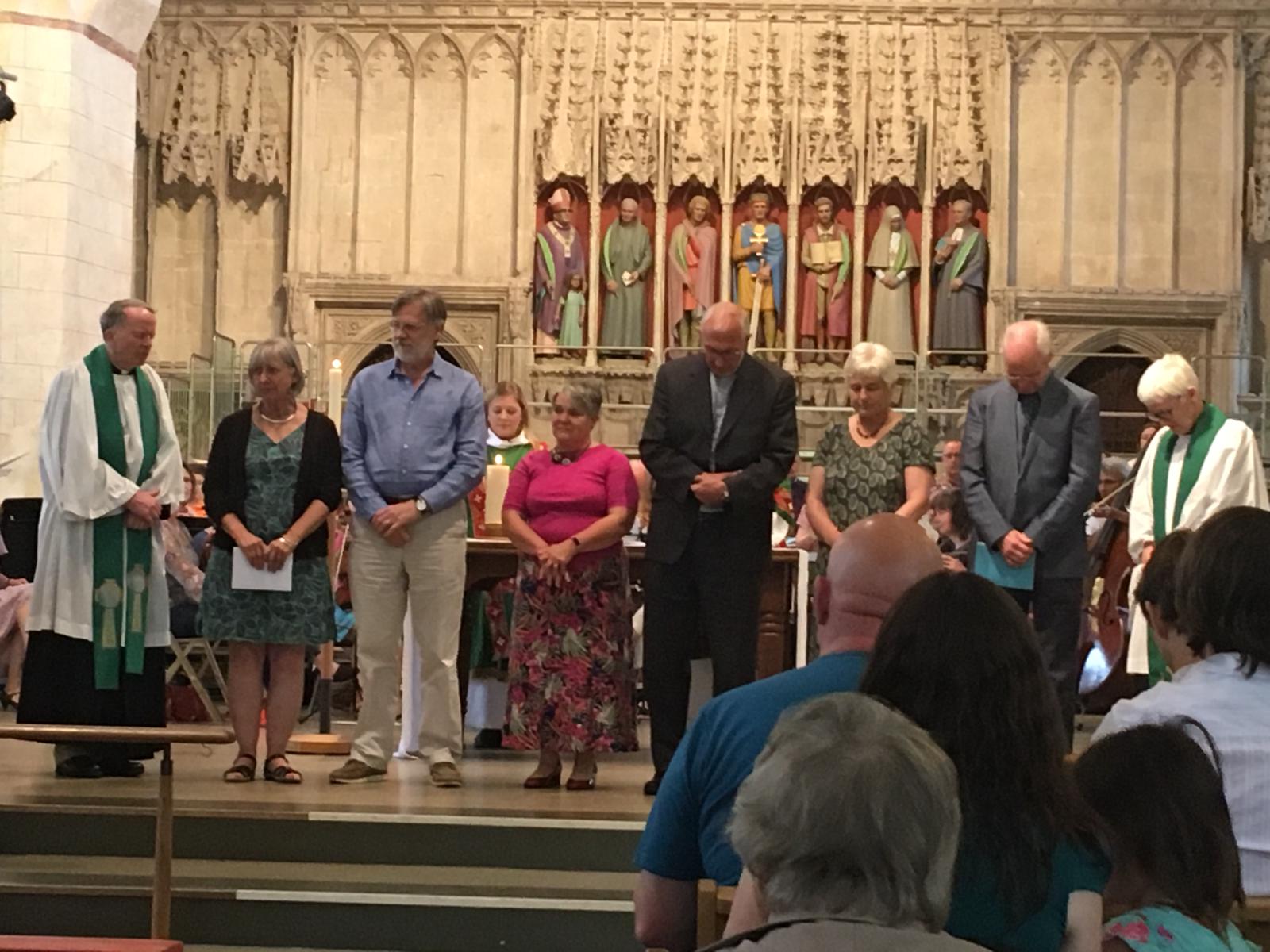

 Hands at Work St Albans Volunteers